Improving short-term memory: what honestly helps
The internet sells memory like a muscle that one app can inflate. The truth is smaller and more useful: capacity is fairly fixed, but how well you use it is not.
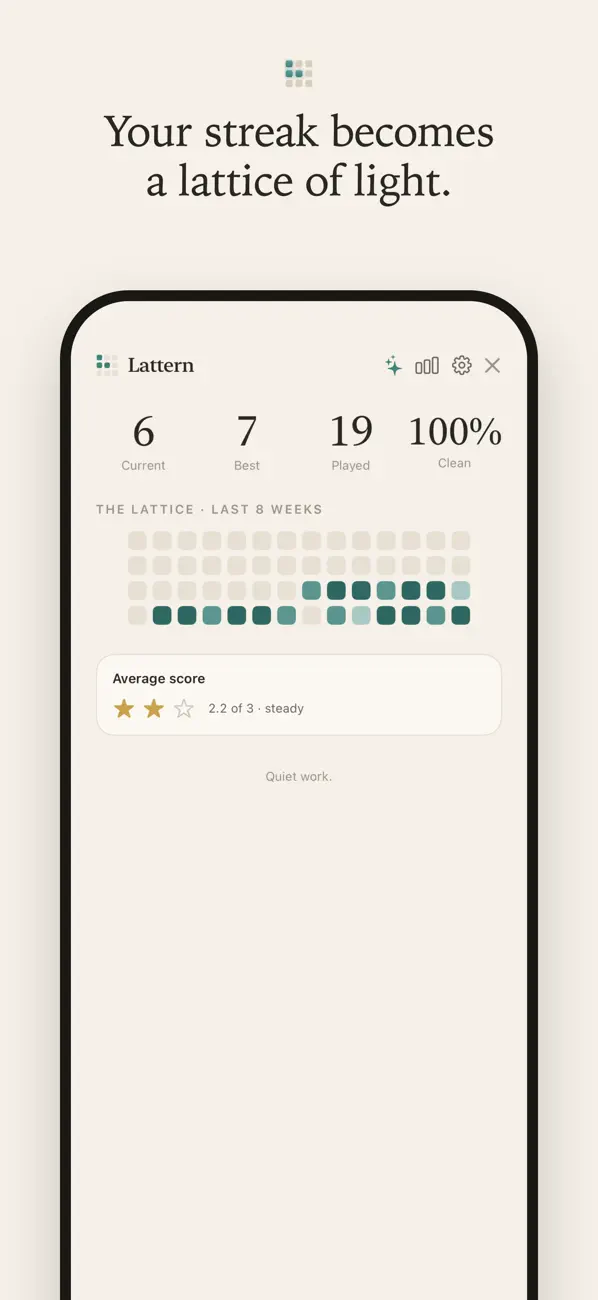
Short-term memory capacity is largely stable in adults, and research on brain-training apps shows practice mainly improves the practiced task. What does help: sleep, exercise, attention management, and chunking strategies that use your capacity better. A daily memory game like Lattern honestly offers focused attention practice and a pleasant ritual, not a bigger brain.
The uncomfortable truth about brain training
In 2016 the FTC fined a leading brain-training company for advertising cognitive benefits its science could not support, and a consensus statement signed by dozens of researchers said the field's evidence for broad transfer was weak. The pattern in study after study: people get much better at the trained game and roughly nothing else changes. Any memory app that promises to sharpen your mind should trigger your skepticism. Lattern's own store page calls itself "deliberately not brain training" for exactly this reason.
What actually moves the needle
- Sleep. Memory consolidation happens during sleep; chronic shortage measurably degrades recall. Nothing an app offers competes with a full night.
- Exercise. Regular aerobic activity is one of the few interventions with consistent cognitive benefits in trials.
- Attention. Most "memory" failures are encoding failures: the information never got in because you were elsewhere. Anything that trains sustained attention helps memory indirectly.
- Strategies. Chunking, grouping, visualizing routes and shapes: these do not grow capacity, they spend it smarter, and they are learnable.
Where a daily memory game honestly fits
So why play one at all? Three defensible reasons. First, attention practice: sixty seconds of genuinely full focus is rarer in a day than we admit, and grid recall demands it. Second, strategy practice: holding a lit path teaches you chunking and shape-reading by feel, skills you will notice in daily-life moments like remembering a gate code. Third, the ritual itself: a small, calm, completable thing every day has value that has nothing to do with neurons.
- Sleep and movement first. They are the actual interventions.
- Play Lattern's daily as attention practice: one minute, fully there.
- Practice chunking on the grid: see shapes, not cells.
- Expect to get better at Lattern. Treat anything beyond that as a gift.
The bottom line
You cannot buy a bigger short-term memory, and apps that say otherwise are selling. You can sleep, move, attend, and chunk, and you can keep a daily minute of real focus in your life because it is pleasant and finishable. That is the whole promise, and it is enough.
Frequently asked questions
Do memory games improve memory?
Then why play a daily memory game?
Today's Lattern is waiting.
A 60-second daily memory ritual. Free on iPhone, Apple Watch, and Android.