The memory grid game, perfected as a daily ritual
A grid lights up, one cell at a time. Then it rests, and you light the same path back. That is the whole game, and it is quietly captivating.
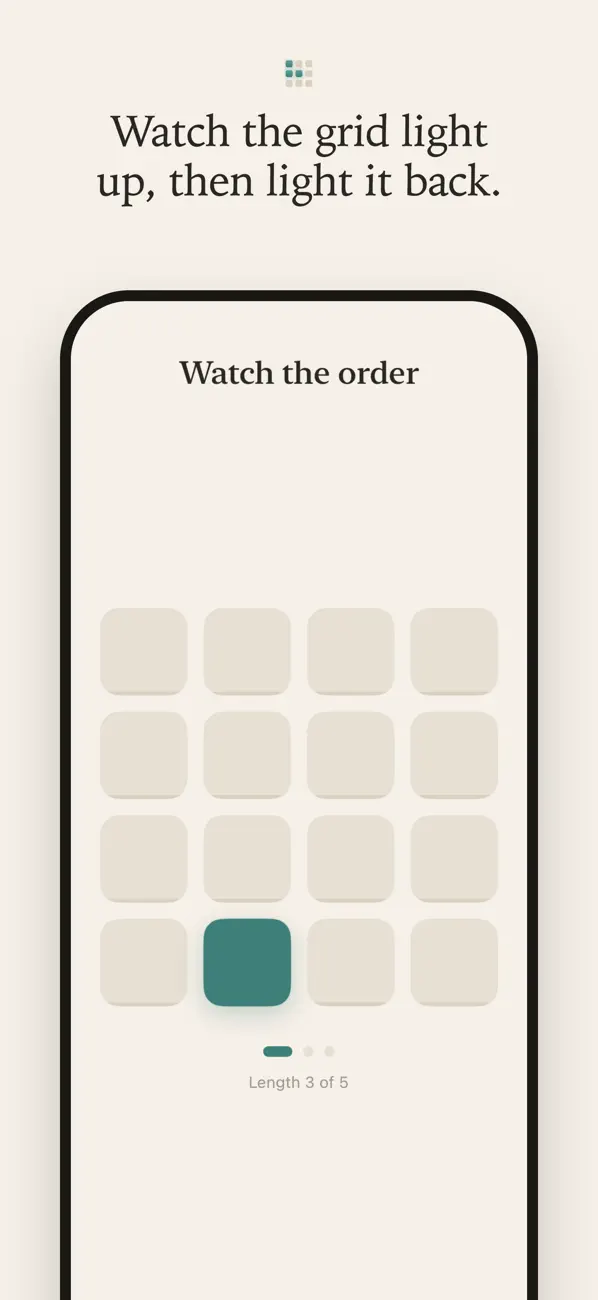
A memory grid game shows you a pattern on a grid, hides it, and asks you to reproduce it from memory. Lattern is a free daily version: each day one grid lights its cells in sequence, you light the path back, and the sequence grows across three rounds. It takes about 60 seconds, and it is deliberately calm: no timers, no harsh fails.
What is a memory grid game?
The format is old enough to be furniture: a pattern appears on a grid, disappears, and you rebuild it from memory. Electronic toys did it in the seventies, psychology labs have used grid recall tasks for decades, and the web made "sequence memory" tests a small rite of passage. The reason it survives is that the loop is perfect: watching costs nothing, recalling costs everything, and you feel the exact moment memory hands the answer back.
How Lattern plays it
Each day there is one new Lattern, the same for everyone. The grid lights its cells one by one. It rests. Then you light the same path back, in order. Three rounds a day, and the sequence builds a little longer each round. Get it, and your Lattice fills in: a quiet calendar of light that grows day by day. The whole ritual takes about a minute.
- Open the app. Today's grid is waiting, identical for every player.
- Watch the cells light in order. Do not narrate, just watch.
- When the grid rests, light the path back.
- Three rounds, each a little longer. Then the Lattice gains a day.
Why position plus order is the interesting part
Grid recall is really two memories working together: spatial memory holds where the cells were, and sequence memory holds the order they arrived in. Most puzzle games lean on one or the other; a memory grid game makes them cooperate. That is why the sixth cell of a path feels so different from the second: you are not just storing more, you are keeping two systems synchronized for longer.
Calm on purpose
Lattern is deliberately not a brain-training app. There is no score screaming at you, no leaderboard anxiety, no claim that this makes you smarter. A miss gets a gentle retry, never a red buzzer. The point is the same as a morning stretch: sixty seconds of full, quiet attention, and a pattern of light that shows you kept showing up.
Frequently asked questions
Is Lattern free?
How long does a daily Lattern take?
Today's Lattern is waiting.
A 60-second daily memory ritual. Free on iPhone, Apple Watch, and Android.