Games like Simon, for grown-up attention spans
Four colored buttons, a lengthening sequence, and that horrible buzz when you slipped. Simon taught a generation what sequence memory feels like. The format deserved a calmer second act.
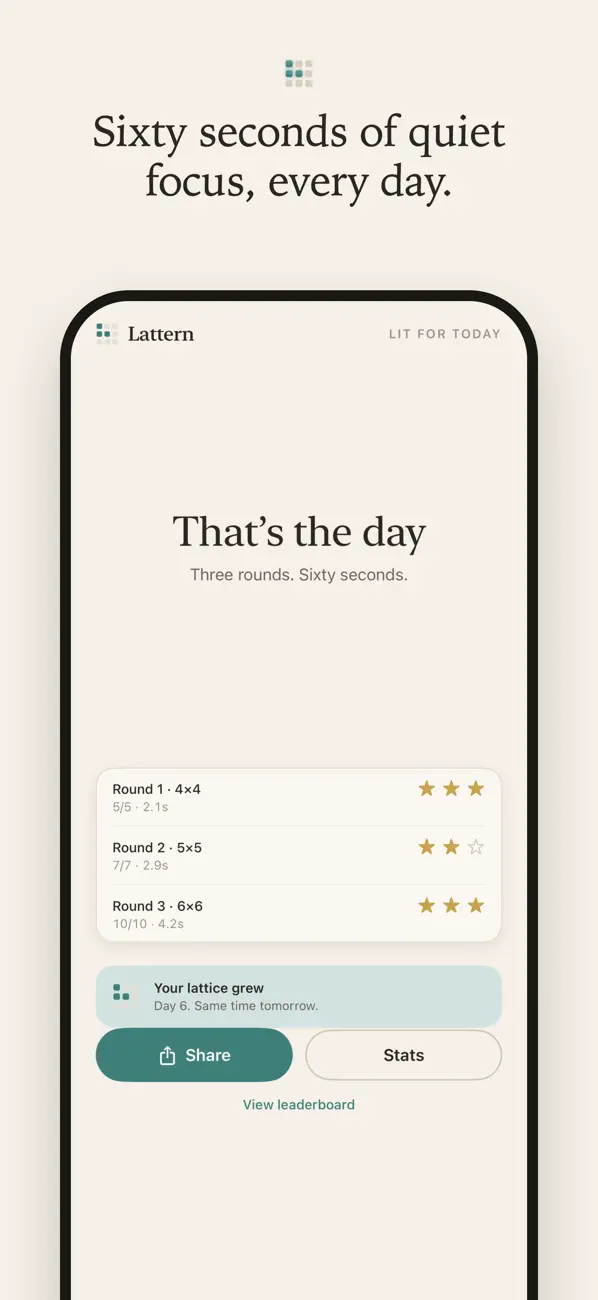
Simon is the classic follow-the-sequence memory game: watch the pattern, repeat it, survive one more step. Modern heirs keep the loop and change the mood. Lattern is the calmest of them: a daily 60-second grid ritual where you light a growing path back from memory, with no buzzer, no elimination, and a streak that looks like a calendar of light.
Why Simon worked
Simon, the disc with four glowing buttons from 1978, is one of the most successful toys ever made, and its design is a single perfect loop: the machine plays a sequence, you repeat it, and each success adds one step. Tension rises automatically, no rules explanation needed. Its only flaw was its personality: the pace quickens, the buzz punishes, and every game ends in failure by design.
What the format looks like today
The Simon loop survives everywhere: rhythm-repeat minigames, pattern-matching party games, and the sequence memory tests that benchmark sites made famous. Most modern versions inherit Simon's adrenaline framing: faster, louder, sudden death. That is fun for a burst, but it turns a beautiful memory task into a stress test, and stress is precisely what recall hates.
Lattern: the Simon loop, without the buzzer
Lattern keeps everything that made Simon great and removes everything that made it cruel. A grid lights a path one cell at a time; you light it back; the sequence grows across three rounds. But there is no acceleration, no elimination, no buzz. A miss earns a gentle retry. One puzzle a day, the same for everyone, done in about a minute. The scoreboard is replaced by the Lattice, a quiet calendar of light that fills in day by day.
- Same skill: hold positions and order, reproduce the sequence.
- New surface: a spatial grid instead of four fixed buttons, so where matters as much as when.
- New mood: daily ritual instead of sudden-death arcade.
Which style suits you?
If you want your pulse up, an arcade Simon clone will oblige. If what you actually loved was that moment of pure recall, the sequence flowing back through your fingers, a daily grid gives you that feeling without the flinch. It is the difference between a carnival game and a morning stretch, built on the same muscle.
Frequently asked questions
Is Lattern like Simon Says?
Does Lattern speed up like Simon?
Today's Lattern is waiting.
A 60-second daily memory ritual. Free on iPhone, Apple Watch, and Android.